TrueNAS SCALE SMB and NFS Share Security
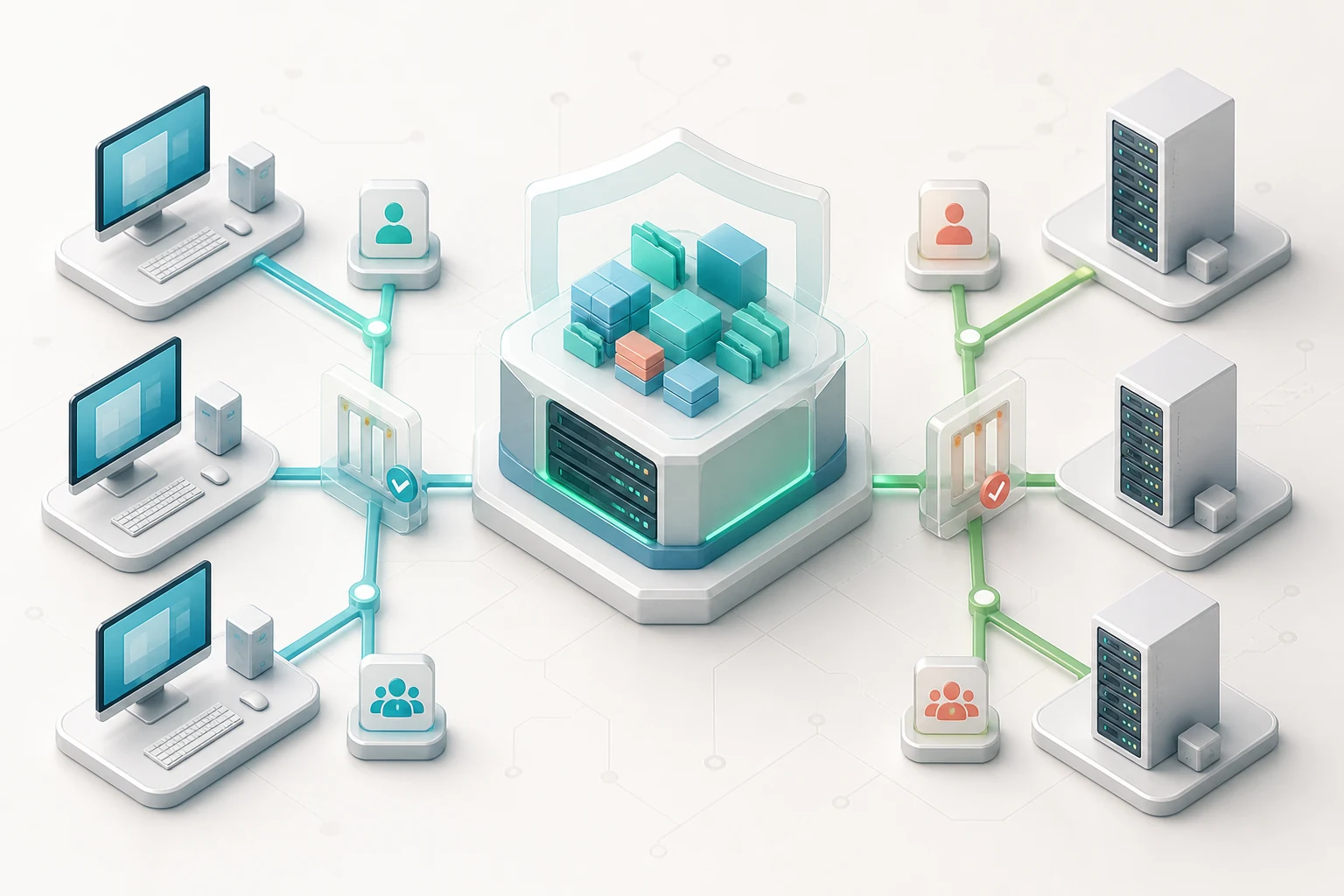
A file share is a controlled path from a network identity to stored data. Security fails when administrators treat only the visible share switch as the boundary and ignore the dataset, filesystem permissions, group membership, client behavior, and network route underneath it. TrueNAS SCALE makes these layers accessible, but the owner must decide how they fit together.
Begin with a dataset and ownership map
Create a child dataset for each collection that needs a distinct access policy, quota, snapshot schedule, or retention rule. Avoid publishing the pool root. A broad root-level share makes inheritance difficult to understand and increases the chance that future datasets become visible to users who were never meant to reach them.
For every dataset, name an information owner, an administrative owner, the groups that need read or modify access, and the accounts that must never have access. Translate business roles into groups instead of granting rights separately to many users. Group-based access is easier to review when someone changes jobs or leaves the organization.
Choose SMB and NFS for clear reasons
SMB is usually the natural choice for Windows clients and many mixed desktop environments. It supports authenticated sessions and integrates with familiar file-sharing expectations. NFS is common for Unix-like clients and application hosts. The protocols have different identity and permission models, so enabling both on the same data requires a deliberate multiprotocol design.
Do not enable a service merely because it is available. If every approved client uses SMB, an unused NFS service adds attack surface and future confusion. If NFS is required, restrict exports to known networks or hosts, understand how client identities map to stored ownership, and avoid assuming that an IP restriction replaces authentication or segmentation.
Design identities before ACLs
Decide whether users are local to TrueNAS or supplied by a directory service. Keep numeric identities, names, and group membership consistent across systems that rely on Unix ownership. Duplicate or changing identifiers can make the displayed owner misleading and can grant access to the wrong person.
Administrative accounts should not be used for routine file access. Give people ordinary accounts for shares and reserve privileged identities for management. Service accounts need a defined application, dataset scope, credential owner, rotation procedure, and expiration review. Shared credentials remove accountability and should be replaced with named users or narrowly scoped service identities wherever possible.
Use least privilege without creating an inheritance maze
Start with the smallest practical set of allow rules. Give readers read access and editors modify access through groups; reserve permission changes and ownership control for administrators who need them. Test inheritance on new files and folders so collaborative applications behave as expected. A theoretically strict ACL that users constantly bypass is not a reliable design.
Avoid piling exceptions onto an unclear parent ACL. When requirements differ substantially, create another dataset and apply a simpler policy. Document whether permissions are inherited, where inheritance stops, and which entries were added for a specific application. Before changing a populated tree, capture a recoverable state and test the change on representative data.
Keep management and shares off the public Internet
Neither the TrueNAS administrative interface nor ordinary SMB and NFS services should be exposed directly to the public Internet. Place the server on trusted networks, filter traffic at appropriate boundaries, and use a managed VPN or another approved access layer for remote users. Limit the management interface more strictly than user shares.
Network segmentation reduces the number of devices that can attempt a connection, but it does not correct weak passwords or overly broad ACLs. Combine segmentation with multi-factor authentication where supported for administration, unique credentials, timely updates, and monitoring. Record firewall rules and remove temporary exceptions after the approved work is complete.
Protect snapshots from the same identities
Snapshots can help recover files after an accidental edit or deletion, but they remain on the same pool. Decide whether ordinary share users can browse previous versions and whether administrators who manage production shares also control all recovery copies. Replication to a separately administered target can reduce the risk that one compromised identity destroys both active and historical data.
If you are still evaluating the platform and its storage-first model, the download TrueNAS SCALE overview describes the relationship between datasets, shares, snapshots, and independent backups.
Test access as real users
Create a small matrix of approved and denied actions: list, read, create, modify, rename, delete, and change permissions. Test with an ordinary member of each group from the actual client operating systems. Administrator sessions can mask mistakes because privileged users bypass restrictions that affect everyone else.
Also test a newly created file, a nested folder, a moved object, and content created by an application. Confirm that ownership and inheritance remain consistent. Save the expected result with the date and system version so later changes can be compared with evidence instead of memory.
Review exposure and membership continuously
Schedule reviews of enabled services, listening interfaces, share paths, client restrictions, local accounts, directory status, group membership, service accounts, and failed authentication events. Remove dormant shares and expired temporary access. Confirm that alerting reaches a person who can respond and that logs are retained long enough for the organization's incident process.
Secure sharing is not a single ACL screenshot. It is a repeatable relationship among data ownership, identity, filesystem policy, protocol configuration, network reachability, recovery, and review. When each layer is documented, TrueNAS SCALE shares remain easier to operate and safer to change.